Laser and Light Hair Removal in Vietnam: The Follicle Biology, Every Method on the Market, and Published Price Ranges in Can Tho
Part of the clinical content series of Lona Home Spa — Can Tho, Vietnam.
① The Problem, Properly Defined: Why Hair Comes Back
The hair you can see above your skin is already dead tissue. It is a keratin shaft pushed up out of the skin, with no blood supply and no nerve supply. Shaving it, plucking it, dissolving it with cream — all of these deal only with the part that is already dead. The structure that actually decides whether hair returns sits well below the surface: the hair follicle, together with its two stem cell reservoirs, the bulge in the mid-follicle and the dermal papilla at its base.
Follicles do not work continuously. Each one cycles through three phases for life:
- Anagen — the growth phase. The dermal papilla is richly supplied with blood, matrix cells divide rapidly, the shaft lengthens, and melanin content is at its highest.
- Catagen — the regression phase. The follicle contracts, the base retracts upward, blood supply withers.
- Telogen — the resting phase. The old shaft still sits in the follicle but is biologically disconnected, waiting to be pushed out when a new cycle begins.
The critical point: follicles in the same patch of skin are not in phase with one another. At any given moment some are growing and some are resting. Every light-based or laser-based method acts meaningfully only on follicles currently in anagen — that is when the follicle holds enough melanin to absorb light and convert it to heat, and when the stem cells sit close to where that heat is generated. This single fact is the complete explanation for why light hair removal must be delivered as a course of spaced sessions: each session reaches only the cohort currently growing, and later sessions catch the other cohorts as they enter anagen.
The physics behind it is called selective photothermolysis: choose a wavelength that melanin in the hair shaft absorbs more strongly than melanin in the surrounding epidermis, so heat concentrates in the shaft and follicle rather than in the skin. Two non-negotiable limits follow directly:
1. Darker and coarser hair responds; pale hair does not. White, grey, blond and red hair carry little or no melanin — there is nothing for the light to absorb. No device and no technology brand overcomes this. 2. The darker the skin, the narrower the safety window, because the epidermis also absorbs light and also heats up. Freshly tanned skin belongs in this same risk group.
Finally, two conditions that are very often confused:
- Constitutional hypertrichosis — plenty of thick hair, distributed in a pattern normal for the person’s biological sex. Largely genetic and ethnic. This is a cosmetic matter.
- Hirsutism — coarse, dark hair growing in a female patient in androgen-dependent areas: upper lip, chin, around the nipples, the midline of the lower abdomen, the inner thighs. If it has appeared or worsened quickly, and comes with irregular periods, worsening acne, crown hair thinning, or central weight gain, then the main work is not at a hair removal device — it belongs with an endocrinologist or a gynaecologist. Hair removal in that situation treats only what is visible while the underlying driver keeps producing new hair.
Telling these two apart before booking anything is the single most money-saving thing a reader can do for themselves.
⑦ Planning a Trip from Abroad — Read This Second
If you are reading this from the United States, Australia, Canada or Europe and planning a trip home, the scheduling question comes before the method question. So we answer it here, second, rather than near the end.
Hair removal has one feature that suits long-distance patients very well, and one that does not. In its favour: every session is short, there is no downtime, and several areas can be treated in a single appointment. Against it: it is a course of sessions spaced according to the follicle cycle, not a one-visit procedure. A two-week trip cannot contain a full course. It can contain one or two sessions.
That is not a reason to skip it. It is a reason to plan it differently.
How returning Vietnamese patients actually use this service. Almost nobody flies home for hair removal alone. In practice, hair removal gets folded into an itinerary alongside other services of the same trip: a facial, a traditional Vietnamese scalp-care and hair-washing session, a massage, and whatever procedures you have booked. Two scheduling rules make the difference between a trip that works and one that wastes appointments:
- Put hair removal in the first days of the trip. Treated skin should not be sun-exposed, and sun exposure almost always lands in the back half of a trip home — beaches, family outings, travel between provinces. Front-loading the light sessions protects them.
- Treat multiple areas per appointment rather than spreading single areas across visits. Each chair session costs you one travel slot, so fill it.
If your trip also includes procedures, Lona recommends leaving at least 2 weeks between the appointment and your flight. This is the facility’s general recommendation; the specific interval for any given procedure is set by your treating doctor. Build your itinerary around that two-week anchor first, then fit hair removal and relaxation sessions into the remaining gaps. The companion recommendation: patients travelling from far away should group procedures into a single trip rather than spreading them across several.
The three distance tiers, briefly. Patients from the Mekong Delta provinces travel to Can Tho and back in the same day without difficulty — hair removal requires no recovery time, so it combines easily with other errands in the city. Patients from Ho Chi Minh City should ask not “is one session worth the trip” but “is the whole course worth it” — for a single small area, repeated travel costs more than the service, so combining areas and combining services is what makes the journey add up. Patients from overseas should treat this cluster as the flexible filler around their fixed procedure dates.
One honest caution. If your trip is one week long and you expect to see a completed result before you fly back, light hair removal will disappoint you — in any country, at any clinic. The multi-year packages exist precisely because this is a long-horizon treatment. Message us before you buy your ticket rather than after you land.
Remote consultation before you fly: WhatsApp +84 777 679 902 · Zalo · Contact@lona.vn
② The Full Map of Methods — Including the Ones Lona Home Spa Does Not Offer
The “offered” and “not in the catalogue” labels below reflect the published service catalogue as of October 2026. If you need a direction that is not listed, ask — if it is not something done here, you will be told so directly and pointed somewhere suitable.
Roughly eight approaches run in parallel on the Vietnamese market. Here is all of them, with a clear statement of which one Lona Home Spa uses and which ones it does not.
1. Shaving, depilatory cream, waxing, threading, tweezing — the surface group Principle: cut or pull the shaft, no intervention at the follicle. Shaving cuts the shaft at the skin line. Depilatory creams break the disulfide bonds of keratin with thioglycolate salts so the shaft crumbles. Waxing and threading pull the whole shaft out of the follicle. Suits: anyone who needs to be smooth today; anyone with pale hair that light cannot treat; pregnant patients who would rather not add any other intervention. Limits: no cumulative effect whatsoever — hair returns unchanged. Shaving creates a bevelled tip that readily curls back into the skin and causes folliculitis, particularly in the bikini area and on the neck. Years of repeated bikini waxing commonly leaves thickened, hyperpigmented skin. Depilatory cream is a frequent cause of contact dermatitis and must never go near mucosa. Lona Home Spa uses shaving as a mandatory technical step before a light pulse, not as a hair removal service in itself. The spa does not offer bikini waxing.
2. Electrolysis Principle: a very fine probe is inserted into each individual follicle and the dermal papilla is destroyed by electric current or by a localised alkaline reaction. This is the only method that regulators in many countries classify as “permanent hair removal” in the strict sense of the word. Suits: white, grey and blond hair — precisely the group light cannot touch. Also very small targets: a few hairs on a mole, the lash line, the lip border. Limits: it treats one follicle at a time. A single underarm already holds thousands. Cost and time for a large area are unrealistic, it hurts more, and the operator’s skill determines almost the entire risk of pitted scarring. Electrolysis is not among the services listed in the published catalogue. Stated plainly: if your hair is white or grey, light will not help you, and the direction you want is electrolysis at a place that specialises in it — not here.
3. Diode laser (typically 808 nm) Principle: a single coherent wavelength that reaches follicle depth, usually paired with a contact-cooled handpiece and a low-fluence multi-pass “in-motion” mode. Suits: coarse dark hair over large areas — male backs, chests, legs. Limits: higher equipment and running cost; because the energy is concentrated, incorrect parameters on darker skin have more visible consequences; more heat sensation in some areas. Lona Home Spa does not have a diode laser. If you reached this page searching “diode laser hair removal Vietnam”, you deserve to know that in this paragraph rather than at the reception desk.
4. Alexandrite 755 nm and Nd:YAG 1064 nm Principle: the two opposite ends of the useful spectrum. Alexandrite is absorbed very strongly by melanin and performs well on lighter skin. Nd:YAG penetrates deepest and is least absorbed by epidermal melanin, which makes it the usual choice for darker skin types and for beard-area folliculitis. Limits: Alexandrite carries a higher pigmentary risk on darker skin; Nd:YAG is the most uncomfortable of the group. Lona Home Spa has neither.
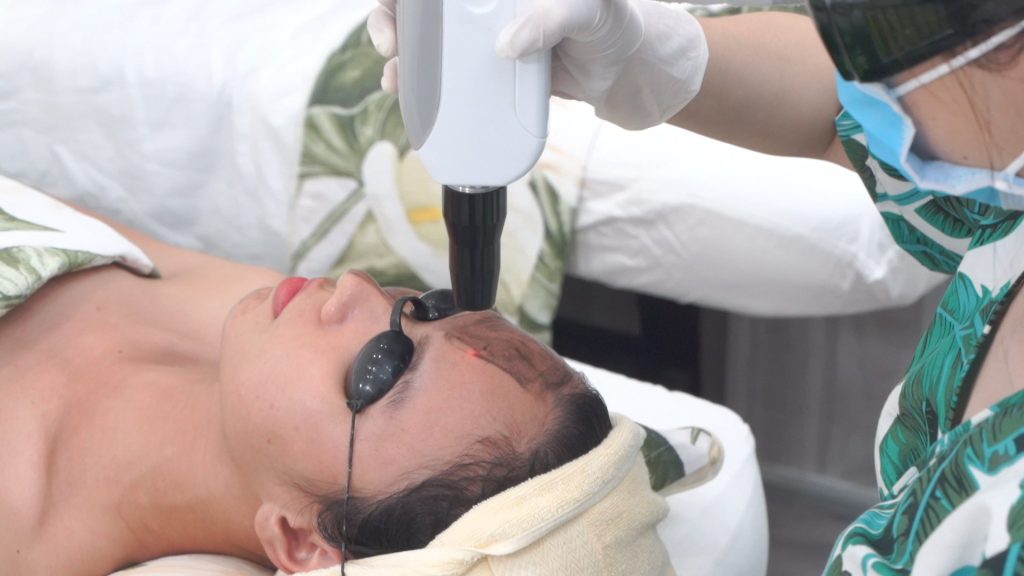
5. IPL and DPL — broad-spectrum pulsed light Principle: not a laser. A lamp emits a band of wavelengths and filters block the ones that are not wanted, keeping the band melanin absorbs. DPL (dynamic pulsed light) is a narrower-filtered variant of conventional IPL, so less of the energy is wasted outside the useful band. A cooled handpiece holds the epidermis at low temperature while the pulse passes through. Suits: coarse dark hair, medium to large areas, patients who prioritise comfort over raw intensity, patients who want several areas done in one appointment. Limits: because the band is broad, energy density per wavelength is lower than a monochromatic laser — comfort is traded for the need to follow the course patiently. And both hard limits from block ① still apply in full: it does not work on pale hair, and parameters must be reduced on tanned skin. This is the approach Lona Home Spa uses.
6. Systemic and prescription topical medication Principle: intervene in the hormonal axis or in a follicular enzyme rather than destroying the follicle with heat. This is the territory of dermatologists, endocrinologists and gynaecologists — with indications, contraindications and laboratory monitoring. Lona Home Spa does not prescribe or advise on medication. For a client showing the hirsutism pattern described in block ①, the correct first step is a specialist consultation, not a hair removal package.
7. Home-use handheld IPL devices Same principle as group 5 at much lower energy, because the device has to be safe in untrained hands. Suits: maintenance between courses, self-visible areas such as lower legs and forearms. Limits: cannot reach the back; adherence collapses for most users; and without properly rated eye protection these must never be used near the eyes or lash line.
8. “Permanent in one session” and “lifetime guarantee” These are not methods. They are phrases. No light technology removes every follicle in one session, for the anagen-cycle reason set out in block ①. Lona Home Spa does not use the word “permanent” and does not attach a percentage figure to hair reduction.
③ Which Approach Lona Home Spa Chose, and Why
Lona Home Spa performs hair removal with cooled DPL technology — and only that.
The stated reason, taken from the service description as published: cooled DPL supports gentle hair removal while limiting the uncomfortable burning sensation during the session. Cooling combined with DPL light produces a comfortable experience and is suitable for many different areas of the body — which is the decisive factor for a facility treating areas as different in skin thickness and sensitivity as the upper lip, the bikini line and the back.
The mechanism is described as what it is, and no more: the course acts on the follicle so that the shaft becomes thinner, softer and sparser session by session, and extends the regrowth interval. That is the language of accumulation, not of one-time elimination. The one published milestone: after approximately 3–5 sessions, clients can usually feel a clear slowing of regrowth, with softer and noticeably sparser hair. Beyond that milestone this article gives no numbers — your actual session count depends on the area, hair colour and coarseness, and hormonal factors, and only an in-person assessment can forecast it.
On course structure: Lona offers flexible packages of 1 year, 5 years and 10 years. Packaging by duration rather than by session count is a deliberate choice, because it matches the follicle-cycle reality from block ① — the real question in hair removal is not “how many times” but “for how long”.
④ Complete Published Price Ranges — All 15 Services
Every figure below is a published list price, before any period-specific offers, and still subject to adjustment according to each client’s individual condition (the true surface area of the region, hair coarseness and colour, and skin condition on the day). Currency conversion: figures in USD are approximate and for reference only, converted at a reference rate of 1 USD ≈ 25,600 VND. Exchange rates move; treat the VND figure as the real one and check the current rate before you budget.
| Code | Service | Brand / technology | Invasive | Area | Published range (VND) | ≈ USD (reference only) |
|---|---|---|---|---|---|---|
| SPA51 | Underarm | Cooled DPL · 1/5/10-year packages | No | Underarm | 499,000 – 2,150,000 | ≈ 17 – 96 |
| SPA52 | Full face | Cooled DPL · 1/5/10-year packages | No | Face | 1,200,000 – 4,350,000 | ≈ 38 – 173 |
| SPA53 | Upper lip | Cooled DPL · 1/5/10-year packages | No | Upper lip | 499,000 – 2,150,000 | ≈ 17 – 96 |
| SPA54 | Half arm | Cooled DPL · 1/5/10-year packages | No | Arms | 499,000 – 2,150,000 | ≈ 17 – 96 |
| SPA55 | Full arm | Cooled DPL · 1/5/10-year packages | No | Arms | 1,295,000 – 4,350,000 | ≈ 38 – 173 |
| SPA56 | Half leg | Cooled DPL · 1/5/10-year packages | No | Legs | 1,995,000 – 4,950,000 | ≈ 58 – 192 |
| SPA57 | Full leg | Cooled DPL · 1/5/10-year packages | No | Legs | 1,295,000 – 4,350,000 | ≈ 38 – 173 |
| SPA58 | Half bikini | Cooled DPL · 1/5/10-year packages | No | Bikini | 2,945,000 – 5,450,000 | ≈ 96 – 212 |
| SPA59 | Full bikini | Cooled DPL · 1/5/10-year packages | No | Bikini | 1,795,000 – 5,450,000 | ≈ 58 – 212 |
| SPA60 | Back | Cooled DPL · 1/5/10-year packages | No | Back | 2,395,000 – 6,600,000 | ≈ 77 – 269 |
| SPA61 | Abdomen | Cooled DPL · 1/5/10-year packages | No | Abdomen | 2,945,000 – 5,450,000 | ≈ 96 – 212 |
| SPA62 | Full body | Cooled DPL | No | Full body | 5,995,000 – 18,250,000 | ≈ 212 – 731 |
| SPA63 | Phytomer Youth | Phytomer · EMS muscle-lifting | — | Face | from 2,500,000 | ≈ from 96 |
| SPA64 | Phytomer Marine | Phytomer · Aqua Peel + peeling + cold electrophoresis | — | Face | from 2,500,000 | ≈ from 96 |
| SPA65 | Phytomer Lumi Skin | Phytomer · AHA/Mandelic/Ferulic peel + biophotonic light | — | Face | from 2,500,000 | ≈ from 96 |
The last three entries (SPA63–SPA65) are not hair removal services — they are three facial care protocols that sit in the same price list. They are kept in this table so it matches the published price list exactly, not to suggest any effect on hair follicles.
Three things to read alongside the table:
- A wide range is not vagueness. The lower end corresponds to the shortest package and the smallest version of the area; the upper end to the longest package and the widest coverage. “Underarm 499,000 – 2,500,000 VND” means the two ends of a real set of choices, not a blurred single number.
- “Half” and “full” of the same area are not proportional, because duration packaging and real surface-area measurement differ between regions. Do not double a half-area price to estimate the full one.
- Bikini and intimate-area pricing is higher than other regions not because the area is “special” but because it is thin skin with multiple folds, the highest follicle density and the coarsest hair on the body — which means more passes, more conservative parameters and longer chair time.
⑤ What Actually Happens in a Session, Step by Step
The following five steps are the protocol applied to the hair removal areas — face, upper lip, arms, legs, bikini, back, abdomen and full body:
Step 1 — Cleanse and disinfect the treatment area. Removes sweat, moisturiser, sunscreen and deodorant residue. Any remaining oil or mineral powder absorbs part of the light in the wrong place.
Step 2 — Shave the treatment area clean. This is the most misunderstood step. Clients often assume hair must be left long so the device can “find” it. The opposite is true: hair standing above the skin absorbs the light and burns on the surface, wasting energy that should have travelled down to the follicle, while producing heat, discomfort and a singed smell. A close shave with the sub-surface hair root left intact is the correct condition.
Step 3 — Apply cooling optical-coupling gel. The gel does two jobs at once: it matches the refractive index between handpiece and skin so light is not reflected back, and it acts as a thermal buffer protecting the epidermis.
Step 4 — Deliver the light-based hair removal pass. The handpiece works in a grid with overlapping edges so no strip of skin is missed between passes. The sensation is usually described as a very brief warm snap followed by a return to cool.
Step 5 — Soothe and restore the skin after treatment. The area is cooled down and a soothing layer applied. This is also when the technician goes through home aftercare.
Data note: the procedure field recorded for SPA51 (underarm) in the internal price list currently describes an entirely different protocol — herbal steam, acupressure, RF waves and mineral mud wrapping, which is the protocol of the body-contouring service group. This article does not reproduce that text for the underarm area because it is not a hair removal protocol. The underarm follows the same five steps above.
⑥ Who Is Suitable — and Who Should Not Start Now
Suitable: anyone with coarse, dark hair; anyone with recurrent folliculitis in the underarm or bikini area after years of shaving and waxing; anyone wearing closed uniforms or working in heat where shaving is hard to maintain; anyone who wants to cut weekly grooming work substantially and accepts a course rather than looking for a one-time fix.
Should not start now — please read this section carefully:
- White, grey, very pale blond or red hair. No melanin means nothing absorbs the light. The correct direction is electrolysis, and Lona Home Spa does not offer electrolysis. We say so in advance so you do not spend money here.
- Recent beach time, prolonged sun exposure, or skin currently tanned above its baseline. Wait until skin returns to baseline. This is the clearest pigmentary risk and also the easiest one to avoid.
- Active pustular acne, acute folliculitis, fungal infection, active herpes, open wounds or sunburn in the area to be treated. Resolve the inflammation first, treat hair second.
- Currently taking medication or using products that increase photosensitivity, or recently finished a course of oral acne treatment. This must be disclosed to the technician — not to create obstacles, but because the parameters have to change.
- Pregnancy. Although there is no evidence that light harms a pregnancy, the prudent principle is to avoid non-essential aesthetic intervention during it. Pregnancy hormones also alter hair growth, so a result measured after delivery is the only meaningful one.
- Female patients with a rapidly progressing hirsutism pattern — alongside irregular periods, worsening acne, crown thinning. The correct step is an endocrinology or gynaecology consultation first. If the hormonal driver is untreated, follicles keep being stimulated and you will see new hair appearing in parallel with the course.
- Anyone expecting “one session and it is gone for good”. If that is the condition for your satisfaction, no light-based method anywhere meets it, and you are better off not starting.
- The eyelid and the immediate lash line. No light pulse is delivered there. A few hairs in that position belong to electrolysis or to a doctor.
⑧ Frequently Asked Questions
Is intimate-area hair removal safe, and what hygiene preparation is needed?
The intimate area is thin skin with multiple folds and high follicle density, so the rule is lower parameters and slower passes than elsewhere — not more intensity. Preparation: shower before you come, use no deodorant or powder in the area, and tell us in advance if you are menstruating so we can move the appointment. If there is current inflammation, itching, unusual discharge or suspected fungal infection, that needs treating first.
What is the difference between bikini and full intimate hair removal here?
The difference is coverage, and Lona publishes two tiers: “half bikini” treats hair visible outside the swimwear line, “full bikini” treats a wider region. When you book, describe the coverage you want in your own words and have the technician confirm it back to you, because naming conventions are not consistent across the market.
Does facial hair removal make hair grow back thicker?
A very common worry. Shaving does not make hair thicker — it creates a bevelled tip that feels coarser. With light-based facial hair removal, the point that genuinely matters is that the face carries a lot of pale vellus hair that does not respond to light, so facial outcomes often differ from underarm or leg outcomes. An in-person assessment tells you which type your hair is.
Hair removal and prices in Vietnam: what does Lona Home Spa charge?
The complete range for all 15 services is in block ④ above, from 499,000 VND for the smallest area to 18,250,000 VND for a long-term full-body package. All figures are published list prices, before period-specific offers, and still subject to adjustment according to each client’s individual condition.
What is the difference between depilation and hair removal?
Depilation handles the dead shaft at the surface — shaving, creams, wax, threading — so hair returns unchanged. Hair removal targets the follicle below the skin so the shaft becomes thinner, softer and sparser session by session. One is a weekly chore; the other is a course of treatment.
What device does Lona Home Spa use — is it a diode laser?
No. Lona Home Spa uses cooled DPL — narrow-filtered pulsed light combined with cooling. Not a diode laser, not Alexandrite, not Nd:YAG. The facility also does not offer electrolysis.
How many sessions will it take?
The only published milestone is that after approximately 3–5 sessions clients usually feel clearly slower regrowth with softer, sparser hair. How many sessions reach the level you personally want depends on the area, hair colour and coarseness, and hormonal factors — only an in-person assessment can forecast that, and this article will not substitute a number for it.
What should I avoid after a session?
Direct sun on the treated area, steam rooms and swimming pools for the first few days, vigorous scrubbing, and alcohol-based or heavily fragranced products on the area. Moisturising and sunscreen on exposed regions are the two things that matter most.
Where can I get hair removal in Can Tho?
Lona Home Spa, at T2 Dinh Cong Trang Street, Ninh Kieu Ward, Can Tho City, Vietnam — part of the same group as Lona Skin Lab Dermatology Specialist Clinic in Can Tho. The facility performs cooled DPL hair removal for 12 body areas, offers 1-, 5- and 10-year packages, and publishes a price range for every area.
I live abroad and will be in Vietnam for two weeks — what can I realistically get done?
One or two sessions, covering several areas each, plus home maintenance guidance for the period you are overseas. If your trip also includes procedures, Lona recommends leaving at least 2 weeks between the appointment and your flight, so message us before you buy the ticket and we will sequence the whole trip at once.
Can men have back and chest hair removal?
Yes, and this group often responds well because the hair is coarse and dark. The back has its own range in the table in block ④. Note that the back is hard to care for yourself afterwards, so you will need help applying aftercare products, and the area must stay out of the sun for the first few days.
⑩ Home Care After a Course
Home care determines part of the result, and very few people do enough of it. Three things, in order of importance:
1. Sunscreen on exposed areas — arms, legs, face, upper lip. This is pigmentary protection, not skin lightening. 2. Moisturise and support the skin barrier on treated areas, especially underarm and bikini where friction is highest. Prefer fragrance-free soothing products. 3. Gentle cleansing — no harsh exfoliants or high-foam products on a freshly treated area.
Sunscreens, soothing barrier-repair products and gentle body washes for this phase are available at lona.vn. Ask your technician which to choose for your specific area rather than buying by instinct — what suits the underarm is not what suits the face.
⑨ Message Us
Message us for a consultation with a dermatologist and a skin-analysis specialist on the protocol that fits you — including a frank assessment of whether your hair will respond to light at all, before you spend anything:
- Messenger: https://m.me/lonaskinlab.vn?ref=cum-15
- Zalo: https://zalo.me/4428027389339512399
- Hotline: +84 777 679 902
Overseas clients: message us before buying your ticket, so we can schedule the whole trip rather than a single appointment.
Lona Home Spa T2, đường Đinh Công Tráng, phường Ninh Kiều, TP. Cần Thơ (T2 Dinh Cong Trang Street, Ninh Kieu Ward, Can Tho City, Vietnam) Hotline: 0777 679 902 · 0932 927 723 Operating licence: 735/CT-GPHĐ Advertising licence: 4770/XNQC-SYT Medical director: ThS.BS Lê Thị Thảo Vy — Dermatology